Easter weekend is over. We are back at our desks- or other improvised work spaces. The kids were all here- including the new model that is just 6 months old. It was a great weekend to learn- It was a lot of fun to see all of “the kids” interact and talk about believe it or not business… It is so rewarding for Marie and I to have a glimpse into the “new economies” and the infrastructure and capabilities that are being developed to keep the new economy moving… Meghan- Fintech and African job and economic development…Dan- DTC underwear of all things… Puja start up DTC companies and Packy….the reformed financier and now business writer… And not to mention Marie who employs more “social technology” than can be imagined in the service of getting organizations to be way better and effective than they ever imagined.
This morning, Packy published the “first year birthday” post for Not Boring- another glimpse into the mind, heart and soul of start up capitalistic sojourner…
These are the Key Learnings from our business in 2013. We hope you can use them to improve the Business of your Business.
Context and Calibration
Alan Kay of the Parc Research Institute is credited with the phrase: “context is worth 80 IQ Points.” We agree. To put the extra IQ points to good use, we think it’s important to put the context to work and calibrate on your own particular situation – or the challenge you are attempting to understand.
During the past year, we observed a number of organizations marketing their goods and services under the umbrella of the “end of the world is near”. The multi-scaled graphs were convincing, but once you peak under the covers, different stories emerge. One of our favorites was the devastating impact the “huge decline in College-attending High School graduates in Pennsylvania – 6,000 students over the next 10 years” would have on our client.
This was an offer of an apologist theme for the Admissions folks from the consultants they hired and was provided as “clear evidence” as to why it would be so tough for the Admissions folks to hit enrollment goals.
Here was the context (based on the data we were provided):
More than 72,000 High school seniors stay in state each year to attend college;
Over the next 10 years, a 6,000 student decline would average 600 per year or .8% decline per year;
Our client’s market share: .4%;
Some calibration:
Student enrollment impact if our client did nothing to improve share: 2.4 students per year
Establishing context and then calibrating the impact enabled the client to focus on the important issue, rather than just wringing their hands and worrying about the devastating decline – and its real potential impact. Context and calibration helped us to take pause and focus on doing something meaningful and important.
The real important task at hand was to focus on regaining and sustaining market share. This leads to the next point.
Main events vs. side shows
Over the past several years, we have been lucky enough to work in several very change-averse industry segments- for clients that were convinced that there was value in bucking the adversity.
Time and time again, meetings, or post-meetings, would lead to the recreation of the facts presented and their meaning. The folks that were recreating history were not being malicious – they were just struggling with the prospects of change, and just how “hard it might be” to work in an environment shaped by different assumptions and guided by new expectations for performance.
The sideshow creation and presentation became the technique du jour to divert attention from the main event. The sideshow didn’t discredit the main event, but it sure was enticing to be diverted by its allure. On the other hand, we wanted to take advantage of situations where cumulative learning and resulting shifting perspectives might lead us to better outcomes. Maintaining that balance is the challenge of dealing with the sideshow matter. It’s also why it can be such an effective technique for folks who want to divert a process of change.
The sideshow diversion approach slows and reduces the intensity of the process of change- particularly when there is a fair amount of lag or cycle time between meetings and gatherings that are focused on the process of change.
To overcome the matter, we had to “name the phenomena” and then gently introduce it in the organization and explore the impact of the sideshow approach. Over time, we built the capability to question whether a “side show” was being introduced- or whether there was legitimate learning that was taking place, opening up new perspectives that needed to be considered.
Our critical step was to name the phenomena and then introduce effective ways of discerning what was happening as the change process evolved.
Power of people to create and drain organizational energy
Appreciation for the power of people in an organization was likely one of the greatest losses many organizations suffered through the recent economic challenges. This seems to be a multi-faceted, circular and self-reinforcing challenge for many organizations, leaders and workers. It may not be pervasive, but it seems to be more of the reality for organizations that have experienced significant challenges over the past several years. It seems that those that are missing the boat are missing it consistently at many points in the process.
Since hiring has not been a keen necessity for many organizations, many have allowed their capabilities to assess and attract the best and brightest atrophy. Hiring processes have become “expedient” and don’t get burdened by establishing and using multifaceted job requirements and comprehensive evaluation criteria to aid the hiring process. People seem to be accepted into positions based on affability rather than real and learned beliefs that people have sufficient experience, expertise, inquisitiveness, attitude and capacity to really do the job. Instead of focusing comprehensively, on the complete picture, too much attention is focused only on the “high spots” and sometimes on the low spots.
Resources to help people develop have been reduced and homogenized. Budget cuts caused many organizations to significantly and disproportionately reduce the resources available help people develop the nuanced capabilities that they and the organization require for future success.
Performance management processes have been less than full of candor. Multi-faceted criteria for success and performance expectations have been diminished and deemed not relevant to the job at hand or to the organization.
Leaders seem reticent to really call balls and strikes based on performance. Perhaps it is the fear of having to terminate underperforming people, and the risk of not being able to refill the position; or more critically, perhaps leaders have given up hope on building and sustaining high performing organizations and are just “keeping their heads down.”
Whatever the cause, the condition is unsustainable: People have to want to and actually grow, develop and perform to deal with new realities and advancements [that competitors may use]. Leaders must continually reshape organizations for success. The organization needs to be positioned to attract the best and the brightest and have processes to secure them.
Leaders can’t continue to satisfice on this point. To sustainably position organizations for success, leaders have to open this dialogue and develop meaningful approaches to deal with the outcomes of the dialogue.
Intuition and Diligence
We are all in awe of the people who seem to get it right all of the time. Many business people travel well on that reputation for a long period of time. We have all come to know that these folks who seem to walk on water have amassed a lot of experience and have sharp inductive skills.
We all rely on our experience and intuition to speed decisions processes. Most times that is good. But, we have also observed that conditions change. As leaders we need to balance our assessment of, and reliance on, past performance. Forgive the political reference, but we need to both trust and verify.
During the past years we have encountered a plethora of situations where great people relied too much on intuition and [past] experience, didn’t recalibrate for current realities and didn’t verify.
During the past year we observed millions of dollars of investments evaporate, because the investors didn’t recalibrate or do diligence. In some cases, what used to be true, is no longer true. In others, and embarrassingly, the assets they thought they were investing in didn’t have the assumed value or prospects to generate the value- and in come cases, just didn’t exist. We observed banks over-advance funds for work that didn’t happen- or didn’t happen where they thought it had happened.
The autopsies on many of these situations seemed to point out a common theme- people felt they didn’t have the time (or were pressured into believing they didn’t have the time) or did not want to spend the resources on the diligence (or perhaps didn’t want to know if the diligence might contravene their intuitionally based decisions). In each of the cases, the time, effort and resources to recover far exceeded what would have been incurred as a matter of due course- before the investments were made. Worse, in each case the real value that emerged was far less than the originally expected value.
As leaders (particularly those of us that have successfully relied on our intuition in the past), we need to develop the ability and comfort to slow down and support our intuition with good recalibration and diligence.
This is really hard for many in a world where we operate as partners and affiliations and have had past success. We need to be able to comfortably look at partners and associates with whom we have done business in the past, and tell them how we are changing our business models to be more fact-based and diligent. We have to become more comfortable portraying this as not being a lack of trust in individuals or organization, but a transition to knowing that the business world has changed and we are trusting both our experiences and current facts and assessments equally.
Inside and outside experiences
Over the last few years we have had the opportunity to work with scores of leaders in different roles and from different backgrounds. Similarly, we have had the opportunity to help clients select leaders for their organizations. In all situations, we have worked with our clients to assess performance.
While successful leaders need to have many different skills, experience, expertise and possess appropriate behavioral attributes, one of the areas I had overlooked in the past was sufficient and appropriate mix of successful “inside and outside” experiences.
Successful inside experience involves working within an organization and its cultures, processes and conventions. Most resumes are chock full of this and it is indeed important to consider.
Outside experience is broader. It involves experience in dealing with Markets, customers, shareholders, unions, suppliers, regulators, financial markets etc. It also involves dealing with the experiences that evolve from those interactions- financings, dealing with regulatory matters, law suits, lost business, supplier performance etc. Outside experience is harder to harness and understand what it might bring to the organization.
Perhaps it is because of the economy and the need to reach out more, or the fact that our work typically requires that we work with people and organizations both inside and outside of our client organization, I have come to appreciate and value the diversity of outside experience more and more.
Since many people spend a lot of their developmental years in one role and in few organizations, many organizations don’t have the benefit of people on their team who have a breadth of outside experience. Many times the “outsiders” we deal with don’t share the same value or values that we might. Therefore, for it is hard for us to “figure them out”. Yet, understanding the world that others work in and shapes their stances on issues is invaluable.
For this reason, I have been more sensitive to searching out people in organizations that possess these outside experiences and to putting those experiences to work. As we have hired new people, I am constantly in search of the evidence that they have mastered “outside encounters”- not always so much by the specifics, but by the generalities of the fact that they dealt with them, are sensitive to them, and have mastered them.
Great information is no longer obscured by data
Having and using great information is obscured by people, or more precisely, leaders in organizations. The tools exist today to extract and organize data in ways that can help create meaningful information. If the information proves valuable, it is relatively easy to develop reporting schemes to present that information either regularly or when it is needed. The technology exists and continues to morph and improve. What frequently doesn’t exist is the inquisitiveness, imagination, the skills and experience to make it happen. What is increasing is the need to understand more, understand more completely and understand faster.
In our experience, the solution to this ubiquitous challenge (ask yourself and any leader: “Are you comfortable that you have all of the right information to effectively run your business”) doesn’t arise from spontaneous combustion. In our experience, the solution arises from an unbending and unrelenting resolve to effectively deal with the information challenge. As leaders we have to commit ourselves to the organizational cause of creating relevant, reliable and readily available information and using it to make fact-based decisions in the organization. As leaders we have to commit to increasing our own understanding of how “all of this can work” and then shepherding, encouraging and requiring the right people in the organization to get up to speed- and deliver the relevant and reliable information in ways that make it readily available to all who would benefit from it.
The good news is that it is relatively inexpensive to create the environment. The better news is that an empowered and enlightened organization can do its job better and enjoy it more.
Relevant, Reliable and Readily Available information is key to improving the business of your business and acquiring the knowledge necessary to make smart moves.
Attached is a recent presentation given at the introduction of Cognos Insight at Overbrook Golf Club. The presentation outlines the business intelligence life cycle as well as provides four case examples where organizations have combined strategic, financial and operational information to make smart moves in their business to create significant value. Click here to go to the Business IQ Presentation
As we pledged when we started, we would periodically share our learnings and affirmations with our friends and supporters. We are a bit late with our learnings from 2011, partly because we were busy, and partly because there was so much ambiguity and paradox operating in our client situations. As a result, we wanted to take time to sort out what we believed to be most meaningful and beneficial. None of our thoughts are groundbreaking, but we believe it is healthy and helpful for leaders to frequently revisit the basics and to question how they are operating in their own areas of responsibility. We hope the following is helpful and not pedagogic. Our intent is to help you improve the business of your business.
Good luck!
Cash is King, Information is the power behind the throne
Creating and managing cash were certainly key to survival in 2011. While there was a lot of focus on cash, few focused on the value of knowledge in the business. Information that can be synthesized has much greater value than cash- as it can grow and renew- and is not really a one or few-time event. Like cash, idle vessels of data and information sit around the organization and are never harvested for the benefit they can provide. While a trait of a successful business is that they significantly invest in gathering and using information, a trait of a company that is struggling to survive- is that they don’t focus on what they can learn about the business through the resident data and information they can create. Like many who develop their careers in cash starved businesses don’t appreciate and are frequently loathe to use cash resources to invest or develop, those that have developed in information starved environments, don’t have an appreciation for the value of information and don’t have the resolve to find out how to get it and capitalize on it for the business.
To help businesses thrive- they have to capture, harness and use all of the resources available to their business.
This past year we have been particularly focused on the collection of Accounts Receivable and have used information in client and payer billing files to reduce outstanding balances and increase cash flow. We moved this organization from one that closed its books 6 times a year and presented corporate level financials, to one that can now close in under 3 days and present business level financial information. This has become information that can help positively impact operations before the middle of the next month, helping business leaders to improve the business of their business.
As leaders you have to strive to know, and can’t take no for an answer
In many organizations- particularly those that are challenged and stressed- it becomes increasingly easy to accept “no” or “we can’t” as an answer- particularly in domain of items that (as the Brits say) fall into the “too hard” bin. Data and information about finances, transactions, operations, and competitors are frequent visitors to the “Too Hard Bin” as it frequently takes less than glamorous actions to make that data helpful and useable. But, this information can be a tremendous resource to the organization- and for all intents and purposes, once it is acquired (usually as a by-product) its development and use is practically free. Knowledge will build and enhanced perspectives will help people in the organization continuously make better, more informed and more aligned decisions.
As leaders you have to set the example by displaying and demanding your satisfaction of a huge appetite to know and understand more about the business. You have to energize the organization to work and think in the same way. As ad-hocracy gives way to fact based decision practices, the organization will respond positively. Wistful and Pollyanna like requests will give way to solid requests and decisions about the business that add value.
Like tough-love parents we have to inspire the organization to search, be innovative and creative in the development and communication of fact based information. We can’t take “ I can’t find it” as an answer, but instead have to know enough ourselves about data and information (and its attendant structures) in the organizations to inspire and guide others about how to access the data, create information and use it in decision processes
You can never fight hard enough to achieve strategic and operational fit and balance in your business
In years like the past one, it is difficult to attract or create additional resource or capacity for your business to work. Yet, many organizations allow existing organizational resources to be wasted and dissipated by continuing with organizations practices and processes that don’t fit with their strategy and prevailing market conditions. The cost of lack of alignment or fit is sometimes difficult to isolate, but we all know that friction and rework sap organizational resources. Lack of alignment and fit, is simply too costly to continue to fund. Further, the folks in the trenches see it and understand it and question why leaders don’t do something about it. That makes the issue an implied question of leadership authenticity, connectedness and understanding.
While this concept is more customarily discussed on the strategic level, we find plenty of daily examples where operational components don’t “fit” together, much less align with corporate strategy and the realities of market conditions. Perhaps it is because in environments where more resources were deployable, resources were “thrown” at patching these cracks, and they really only protruded when those resources were taken away.
The issue of strategic alignment is of course critical, but it seems that until organizations that are underperforming, can’t address operational fit issues they don’t or won’t have the capability to address the more critical issue of strategic alignment. So the first step on the path from surviving to thriving is to deal with the issue of operational fit.
We encountered one organization where the monthly payroll exceeded revenues in 8 months of the year; the workforce was only 30-40% productive by the most basic of measures, yet 40% of transactions were allowed to pass through business systems with critical errors. While you could argue, that the organization was overstaffed- it was even more of a shame to see that the obviously excess organizational resources were not deployed to fix critical business processes and the related data and information quality issues that resulted.
In most cases, significant leaps in organizational performance can be made in a cost neutral way. It requires vision, engagement and clear thinking, but can indeed be achieved. Organizations that can’t take the first step to improvement will likely not be able to make a leap to outstanding organizational performance.
Our job as leaders is to help the organization build and sustain this most basic of “muscles” and to inspire and lead the organization to above average performance. This resource can create its own energy, replicate itself each day and make little waste, making this activity one of the “greenest” that can be undertaken in any organization – Now!
Build and develop leadership and management capacity throughout the organization- use it and don’t work around it
The silent victim of the recession in the business world has been the “surviving workers”. They have seen colleagues’ careers interrupted, and have seen their own somewhat stymied. Lack of growth has staunched opportunity for real advancement and the few “field promotions” that have taken place because of reassigning work etc. because of reduced resource levels, have not been the type of advancement to which many aspired.
Many organizations that were development oriented had to reduce budgets in this area, so real development opportunities have been placed on hold. As a result, the surviving resource is (and has been told to be) appreciative that they are employed, but many are frustrated and looking for developmental pathways. The frustration suffered by many is deafening- it is just that its roar is overshadowed by many other challenges being suffered in the organization.
As the economy brightens, one of the first areas for companies to invest will be in the development of existing high potential employees. They should be challenged with developmental opportunities and rewarded with positions of increasing responsibility. That investment will have to be conditioned.
In many of the challenging situations we encountered, we have observed senior management frustrated with performance in the workforce, and instead of making the tough and right people choices, they have let underperforming management in place, and instead “go around them” to people they trust to get information, make decisions and implement change. In place management can feel the neutering that is taking place, and while initially appreciative of the “vote of confidence” they question the authenticity of the management practice- and wonder if they will be next.
For organizations to move from surviving, they will have to objectively assess the people talent in their organization and make the right management decisions to put the right people in place to lead the transition from surviving to thriving. They will have to develop the people and establish the conditions for their success. Satisficing will not be a successful strategy to effectively make the transition.
You can no longer just tell people to change
This year has been profound in terms of refining our understanding of the conditions and the “moves” necessary to set the stage for and realize successful change. We are not talking about gratuitous or peripherally beneficial change, but basic fundamental changes necessary to “stay in the game”. We observed in great detail the approach followed by many- just tell them to change (parenthetically: they ought to be happy to have a job) and they will do it. This was an “expedient change model” for tough times- and then when the desired outcomes did not take root or happen- the “changees” failed and it was their “fault” that it did not happen.
Instead- in good times or bad, it is the responsibility of leadership to set the conditions to enable and promote change- and to establish the strategies that are based on solid principles and objective assessment of the situation.
The change strategies have to be based on:
A solid assessment of the organization’s capability to change- the intersection of the understanding of its willingness and capacity to change
The depth of change required
The pace of change required
Moreover, the context for the change needs to be firmly established, communicated and understood. To give the people a chance to embrace the change, the need to at least understand, if not (preferably) embrace the need to change.
Lastly, the vision for the end state needs to be clear. It is best if that end state is mutually created by interdependent members of the “system”.
The days of merely telling people (and employees) to change are over- in all but the evacuation of a clear emergency situation.
We hope these learnings and affirmations are helpful to you. We don’t think we have broken new ground with what we have learned or affirmed in the past year or so, but we believe it is important for Leaders to frequently focus on and take courage for action from the basics.
We wish you the best for a healthy, happy and prosperous 2012!
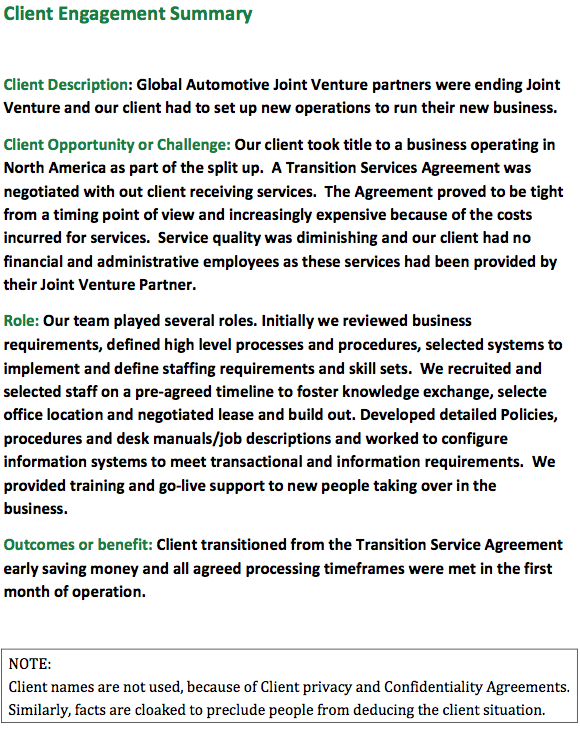
Client:
$ 50 million Troubled Waste Management Firm
Client Opportunity or Challenge:
Combination of economy hammering the building sector and regulatory challenges that overwhelmed the resources to manage them combined to force company to wind down business with insufficient resources to satisfy all obligationsOutcomes
Role:
Assess true financial condition
Develop, present and negotiate wind-down plan with Bank and other creditors
Work with company to secure and negotiate company or asset sale to fund wind down
Outcomes or Benefits:
Successfully negotiated Letter of Intent for sale of assets
Presented sales plan and waterfall to bank for approval; bank approved structure in principle; Bank, key professionals and critical creditors would have received payouts to satisfy portions of obligations due. Bank told us (regrettably for them) that they learned more about the company, the business dynamics and its markets in the first presentation we made than they understood when they underwrote the loan
Bank’s lawyer interfered with deal; Seller walked from transaction and most recent offer was for 8% of original agreed price
Built on more than 30 years of experience, we tailor services to meet our client’s needs. For an overview of our capabilities and point of view, read: 20110425PMCCI Services v2
PMCC Ventures and Pat McCormick have significant experience in helping challenged companies deal with their realities and options. Our services cover most all requirements of of a business struggling to perform in tough economic conditions. We focus on Operational Improvements, Working Capital Management, Organizational Effectiveness, Business Strategy and Business plans, Lender and Investor Relationship Management including negotiation of key agreements related to challenged companies. For more insight, continue reading…
In most instances, enhancing financial management capabilities will require that leaders not just focus on that which can be made more effective and efficient- that is obvious and easy and does not create a lot of value. Instead, Finance leaders will have to both focus on efficiency and at the same time focus on what has been missing and create those capabilities from the “ground up”.
I recently attended a local CFO Breakfast. The breakfast theme was financial leadership-and it lead to a lot of different interpretations in the discussion- but some common themes emerged and not all of them are new.
Role of finance
How can finance “get more respect” be more vital etc?
What should finance be working on….
The answers are of course: It depends on the individual circumstance. I go to the school that all improvements are good improvements- and that the value of investing in upgrading capabilities will eventually accrue to the organization. However, absent a specific change agenda, I suggest that Finance Leaders consider the following scenario and plan their mid to long term development agenda around the needs suggested in the scenario below:
Investors will always demand incremental returns….
There is significant cash on the sidelines of public companies and investment funds
So …Companies will have to invest or return cash to shareholders or limited partners- which for a whole host of reasons, there is a general reluctance to do so…
Hence …there is pent up demand to invest- and in the Spring of 2011 this is playing out in the volume of announced large strategic deals
Meanwhile,,,, Banks are offering less leverage than once considered “normal”
And…. Lack of leverage staunches the ability to increase returns using financial engineering techniques
At the same time it appears that…. developed economy countries economies will not grow very rapidly in the near term and therefore not provide volume growth opportunities to the market
Hence….“Class of 2011 and likely 2012” deals will have to get their returns the old fashioned way- they will have to earn them through
Market Innovation- new products and new markets
Operating excellence- achieve best cost operations
Working capital creation and increased velocity
Causing…. the overall competitive environment to intensify as mergers and acquisitions that are sure to follow an economic downturn take place but in new formats and capital structures
And….place pressure on all competitors for enhanced performance
Which… if not properly managed could start the economic challenges giving rise to this scenario to start all over again…. Just when we thought we were emerging….
To deal effectively in this environment, companies and their finance leaders will both have to ensure that the skills and capabilities in the finance group are sharp as well as ensure that the organization as a whole understands and is focused on driving returns for the business.
If these assumptions are plausible for your organization, it stands to reason that companies will need to have above average capabilities in most all of the five following domains. In fact the capabilities will have to be so good that they will both enable profitable innovation and growth- as well as pave the way for solid operating performance- and today, not many companies are necessarily good at both.
Domain
Relative Financial Management ability required in the business
Financial Planning, Control and accountability
Businesses will have to plan with more rigor to ensure that scarce resources are allocated in ways that will drive value and produce measurable results in the expected timeframes; Accountability processes will have to be real time and responsive to changing market conditions and company performance.
Information for Decision Making
Business leaders will need to have relevant, reliable and readily available information where and when they need it- in the formats that promote insight and compel action.
Cost Structure Understanding
Companies will not have just have to have low cost- they will require a best cost approach to the business- that is integrated- investing, cost cutting and operating rigor can’t operate independently. For success, they will have to operate together. Capabilities will have to be in place so that people designing operations are doing so with the cost structure in mind so that they can make appropriate optimizing trade-offs and decisions.
Business Literacy
People planning and commanding resources will have to have a firm sense of the business of the business of how profits are earned and value is created so that they can make real time tradeoffs and decisions.
Working Capital
Capital deployment will be key. Idle assets will have to be turned into cash and invested or used to meet the capital requirements of the business. Similarly, returns on new capital invested will have to be closely monitored to ensure sustainable value creation.
Time is tight and the stakes are high. Financial leaders will have to take stock to ensure that not only do individuals in the business possess capability and capacity in these domains, but that the fundamental business practices and processes are in place to effectively use and deploy these capabilities. Some organizations will have to do some quick make or buy analyses to determine their organization’s own capabilities and the most expeditious path to developing and deploying them.
How do you rate your organization’s abilities in these domains in light of your business requirements?
What can you do to ensure your finance organization is up to the task?
What’s in the way of you accomplishing what you need to accomplish?
The subject of Effective Financial Management (EFM) seems to be a perennial favorite. Welcome to our inaugural blog on the subject.
EFM has been a favored research topic for educators and consultants alike. The subject while likely around since shortly after the creation of double entry bookkeeping which seems to be around 1211 in Florence Italy, really came into focus in the mid 1980’s as companies were stretching their resources (and those of many of the manager-owners) to accomplish leveraged buy-out transactions. Up until then, keeping score was the role of a few people in the organization whose offices did not have great views. However, once people started putting their own money into the game, the desire to know where you stand began to build. Further, the basic need for “safety” helped to move the concept of internal control out of the “nuisance column” and into the – “this is a good idea- even if it creates a bit more work column”…. ERP advances and the desire to cut cost lead to EFM’s focus initially being placed on transactional efficiency. Shared services, and outsourcing created the opportunity to create both economy of scale- and economy of intellect (just how lucky were you to have the best accounts payable supervisor in each of your 29 locations that paid bills….?) by co-locating people doing the same tasks.
The ENRON era related failures created additional control requirements mostly on the reporting side of the business with the apparent goal of creating an environment that financial leaders would be much better prepared to describe exactly how the horse left the barn when it was decided to keep the barn doors open to avoid the costs of running the fans….
Yet these might not have been all that potent since we are still at a loss in coming to grips with just exactly happened on Wall Street in our latest series of financial challenges- and why “whatever it was” wasn’t reported sooner and more clearly. Most of us are waiting with baited breath to understand the full scope of new government regulation that will help with these challenges in the future.
And the debate rages, blame is laid and elixirs abound. Yet, there are still many different definitions- and degrees of rigor applied to the answer of the question of: ”just what is Effective Financial Management”. The debate is still a bit uncomfortable because some of the outcomes might not be “doable” for many organizations because many are still debating just “what is the role of finance” and if you can’t get your status in the organization settled- it might be tough to acquire or develop the resources to create EFM.
Having been on the EFM quest for 30+ years, we know there are a lot of good people with good ideas- some basic- and others game changing about how to create a business environment that enables more Effective Financial Management. With that as background, we launch this Effective Financial Management Discussion Forum.
We want to run this as a true discussion forum with rich and thought provoking conversation emerging. Since we are all at the same time, operators and investors, it is in our best interest for companies to improve the effectiveness of their financial management.
To put the ball in play- we ask a few simple questions: To create a more Effective Financial Management environment or capability for your organization what would you have to:
Thank you for joining in on our Maiden Blog. The inspiration for the blog about “Improving the Business of the Business” has come from several friends- all in different roles- but all in the search of wanting their businesses to be better.
Over the past few months, we engaged several people with the question: “Do people in your business [who manage resources and whose decisions have an impact on strategic, operational or financial performance] really understand the business of your business- how you create value and make profits?”
Generally, after a recognition smile emerges, the conversation opens and covers a range of current concerns, and aspiration that once leaders developed and objective and shared view of the real “Business of the Business, a lot of potential will emerge.
The conversation engendered a lot of rich dialogue and we thought it might be really informative to engage a wider group on the subject. We think it might be timely, because as the economy begins to turn, it would be refreshing to turn thoughts from merely surviving- to thriving. We also believe it is a fundamental question because this understanding (or at least this set of beliefs) should be the starting point for assessing your own business, its performance, devising strategy etc. Without this settled, the foundations of strategy, day-to-day operations and ultimately performance could be at risk.
We thought this might make for a rich conversation topic. I know that most all of the people on the initial announcement have an interest and a passion in always improving the Business of their Business- and can only assume that many of their contacts share the same passions. We encourage you to share this topic with folks you think might have some sharp insights- and drive up the quality of the conversation and benefit from it as well.
We hope to host and operate this as a legitimate Discussion Forum- with a rich conversation as opposed to a monologue with a few comments thrown in for good measure and feaux legitimacy. We will see where this journey takes us and once we get a few of these “logs on the fire” we can really jump off into some meaningful conversation.
So- we leave you with a series of related questions:
• What are your thoughts on the importance of a shared agreement among business leaders with regard to the essence of the Business of their Business- what does it take to create and sustain value?
• What are the critical elements to consider as you embark on “improving the business of the business”?
• If you could do just one thing to improve the business of your business- what would it be? – and what’s holding you up from getting it done?