Category: Discuss: Improving the Business of the Business

  • Balancing Value Creation and Cost-Cutting: A Strategic Imperative for Today’s C-Suite

    Or, don’t just lunge at cost cutting- adopt approach that helps to focus on value creation and cost alignment

    In the current business climate, the challenges are twofold: sustaining profitability and maintain the capacity for value creation. There’s a heightened focus on cost-cutting as the immediate remedy for financial ailments. However, knee-jerk reactions can be detrimental in the long term. This post aims to shed light on the equilibrium between cost management and value creation that C-suite executives must strive for, especially in middle-market companies with revenues between $50 million and $5 billion.

    The Temptation to Just Cut Costs

    We are in a phase of the business cycle where cost-cutting seems to be the elixir to all problems. The media spotlight on downsizing and operational cutbacks can tempt leaders to make hurried decisions, focusing merely on reducing expenses. This approach may show quick wins, but the medium and long-term implications often offset these immediate benefits.

    Lessons from the Past

    The history of Leveraged Buy-Outs (LBOs) in the mid-1980s offers valuable insights. The dominating narrative was to “cut costs,” and it seemed like the logical step to generate sufficient cash flow to service debt. However, many businesses realized that this approach was not sustainable ad many cost cutting only exercises diminished the ability to quickly pivot as competitive positions changed  and the goal was not just to survive, but be prepared for value creating exits that rewarded owners and investors for the risk they undertook.  As it turns out, the goal is common, but indeed the approach does depend on your starting point, and capacity and capability to undergo change.

    Assess, Plan, and Act

    Before embarking on a cost-cutting mission, it is crucial to take a step back and assess the situation you are encountering- “why you are here” the competitive environment and ultimately what you are trying to achieve.  Here are some thoughts that might help sharpen your team’s thinking about the challenge and the opportunity.

    1. Alignment with Core Strategy: Make sure that changes you make and the resulting  cost-structure, supports achievement of your value creation goals, as well as your short term actions necessary to “weather the storm”. 
    2. Future-Readiness: Cost-cutting should not come at the expense of innovation and future growth that is in line with your goals and mid and long term value creation.  At the same time, this concept should not paralyze the efforts to get ahead of the real challenges you face.
    3. Employee Morale: Dramatic cutbacks can have a cascading effect on employee morale and productivity, affecting your most critical resource.  And at the same time, our experience is that many employees question what took leadership so long to come to grips with these critical matters.

    Balancing the Scale: Value Creation and Cost Cutting

    To achieve sustainable growth, businesses need to find a harmonious balance between cutting costs and adding value:

    • Invest in Talent: Reducing headcount may bring immediate cost savings, but investing in the right talent will yield productivity and cost gains along-with mid and long term value creation.
    • Technology as an Enabler: Instead of slashing technology budgets, consider how automation and digital transformation can lead to both cost reduction and value addition.  Also consider how technology can be used to both improve outcomes and help key employees do their jobs better and feel like they really contribute to the success of the business.
    • Customer-Centric Approach: Instead of compromising on customer service, explore ways to enrich customer experience. This is a powerful energy source for these efforts and the business
    • Data-Driven Decision Making: Utilize data analytics to identify inefficient processes and operational bottlenecks. This approach enables informed decisions, rather than across-the-board cuts.

    Conclusion

    Cost-cutting is not inherently detrimental; it becomes so when it overshadows the more vital goal of creating value. As a C-suite executive, your role isn’t just to survive the downturn but to position your company for future opportunities. By maintaining a balanced approach between cost management and value creation, you are laying the groundwork for sustainable growth and long-term success.

    For a deeper discussion and more targeted strategies on balancing these aspects, just click here

    https://pmccinteractive.com/wp-content/uploads/2023/09/20230918-value-creation.pdf

    Or reach out directly: pjm@pmccventures.com or  calendly.com/pmccventures-pjm-4
  • This might be part of the [apparently] secret formula necessary to help you Improve the Business of your Business

    Active observation over the past several years suggest that curiosity seems to have dampened. Perhaps it is the fear of “doing deep dives” in situations that we fear might become uncomfortable. Perhaps it is remote working- or perhaps it is mentoring and leading that is not geared to the realities of our current workplaces.

    For whatever reason, we have to come to grips with this and really build this capacity in all sorts of organizations. Take a quick read of this, and spend more time assessing your own situation:

    https://www.fastcompany.com/90782370/why-we-should-embrace-radical-curiosity-and-learn-to-ask-better-questions?utm_source=newsletters&utm_medium=email&leadId=769432&mkt_tok=NjEwLUxFRS04NzIAAAGGl93cUD0tiBqiCILiqG9sDYBQJq_laztr0VQwMHYcfEw6nq0feW_S9-qdGDRIKqSuKeVVN69Yy-PqDFFQfqw8G8uY_YqoWhoPE6jcUA

  • Systems Thinking- When the going gets tough, go back to the basics

    As many know, there is an abundance of e-commerce data ranging from web site visits through sales and abandoned carts etc.  The data is arrayed over many different timeframes and it can be overwhelming to make sense of it and use it to shape generative decisions for growth. Because of some client work, with regard to sales growth- and all the levers you might push or pull to accomplish that, my focus turned in greater detail  to systems thinking and systems dynamics modeling as a way to reduce clutter and focus on the decisions and items that count. In other words, get back to the basics.

    AND

    I could not help but think that  systems thinking and systems dynamic modeling can add to our understanding about the progression of the Corona Virus and the impact it might have on us individually, our companies, the markets in which we compete etc.  As individuals we don’t have enough data to build a systems dynamic model, but thinking about what we read and hear with a systems thinking mindset, might help us make more sense of what is going on around us.

    I first encountered these concepts when reading Peter Senge’s book The Fifth Discipline.  I was lucky enough to participate in programs with some of the leaders in this field.  Since then, I have always been on high alert for  recognizing systems, articulating their performance and trying to understand why things happened the way they did- and moreover, trying to understand what alternative outcomes could be achieved if the system was “tuned” differently.  But- I moved away from detailed documentation and modeling- and now I will invest time to enhance my learning and focus my understanding.

    I have made a personal decision to turn as much of the downtime or extra time that has been freed up because of the pandemic into an investment, vs. just spending it on random things.  I am going to focus more effort to deepen my understanding of systems thinking over the next few weeks.

    Also- the quiet time might also provide and opportunity to think through your life or business in this way, so that you are well prepared to “bounce back with authority” when the smoke clears.

    We would love to hear about your personal investment and what you hope to achieve.

    If this is of interest to you, particularly with the corona virus disease state,  I am listing some resources below:

    MIT Systems Dynamics Introduction  https://www.youtube.com/watch?v=AnTwZVviXyY

    Intro to systems dynamics modeling  https://www.youtube.com/watch?v=IenySRdkRu8

    Classic systems archetypes from Pegasus and Dan Kim  https://thesystemsthinker.com/wp-content/uploads/2016/01/PG01E-System-Archetypes-at-a-Glance.pdf

    Introduction to a basic system systems dynamics modeling software product  https://kumu.io/stw/insight-maker

    Good luck.  Stay Safe.  Stay Well.

  • Four organization traits that enabled high performing efforts in 2019

    We have pledged to share insights that we think might be useful to our friends and clients businesses and organizations.  2019 provided a lot of learning experiences and we have identified four significant traits that we think helped to distinguish high performing efforts:

    • Information, Knowledge and Action leading to capturing and sustaining value
      • They have great business intelligence- have the right information and know a lot of context about their businesses and organizations (and their competitors) and act upon that to their advantage
      • They know what drives value and have keen insights about the ingredients to the value
        • Where do you make and lose money?
        • What is growing and lagging?
        • What the leading indicators suggest might happen?
        • What are the trends emerging that have not yet settled in?
      • They think and act systemically in their analysis and response
      • They develop and act on both enduring and flexible plans to capture and sustain that value
      • The whole team knows what drives value and embeds it in their thinking and actions
    • Get the homework and hard thinking done “up front” and act proactively more than reactively
      • Think through the risk and reward in their work
      • Explicitly bring facts to the table and decision making process
      • Do diligence and ask appropriately tough questions
      • Document necessary legal agreements and cover for the “downside”- willing to spend a few more days negotiating than suffering challenges for years to follow
      • Know that it is too costly to deal with the unexpected or negative outcomes later- so they do their best to get the hard thinking and work done upfront
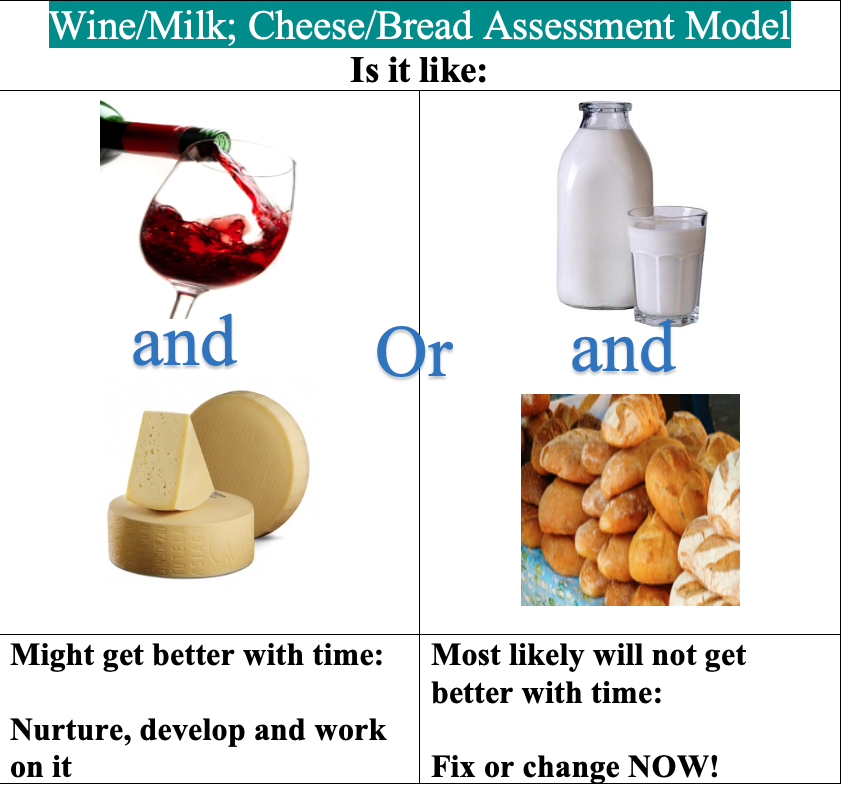
    • They employ the Wine/Milk; Cheese/Bread Assessment Model  for the opportunities and challenges they face:

    • Build and rely on the Team:
      • Think hard about the skills and experiences they need on the team and relentlessly pursue the right people- and don’t satisfice
      • Provide frequent and meaningful developmental experiences for their people:
        • Explicit and accountable endeavors
        • Endeavors important to the success of the organization
        • Guaranteed to shape perspectives, broaden scope and deepen skills
      • And if things are not heading in the direction they hope- See above: Wine/Milk;   Cheese/Bread Assessment Model

    For more information refer to: https://pmccinteractive.com/2020/01/24/background-information-for-pat-mccormick/

  • When the lower cost providers innovate- others need to take heed!

    Great article in this morning’s Philly.com.  http://www.philly.com/philly/news/20151113_Rowan_offers_a_cheaper_three-year_plan.html

    Public Universities are growing, while many private universities are struggling.  It was so refreshing to see a school like Rowan, take a move that benefits both the University and its students.   I think that Rowan offers a good landscape for others to consider how they might want to advance the  ball, as Rowan has really grown and developed over the past several years.  Hats off to Rowan and its leaders!


  • US Higher Ed needs to master the learning curve and smartly deal with excess capacity

    It has been an interesting few weeks for Higher Education.  Last week, the Economist published a great article on the need to reform education—the challenges demanding it, and the factors accelerating the ability to transform.

    In the past few weeks, several Pennsylvania liberal arts colleges announced a wide spread coalition to discuss ways of “helping with costs” and creating advantage.

    In mid June, leaders of several Philadelphia Universities met to discuss ways to collaborate to help Philadelphia Universities enhance their abilities to cope with an increasingly competitive environment and substantial cost pressures.

    These are great signs.  The common press is starting to bring the issues both into focus and position them in an appropriately broad context.

    http://www.economist.com/news/leaders/21605906-cost-crisis-changing-labour-markets-and-new-technology-will-turn-old-institution-its

    http://www.philly.com/philly/blogs/campus_inq/Ten-Pa-liberal-arts-colleges-to-collaborate-on-cost-savings.html#YlsCvbs6ekVxE2XI.9

    Attached is a brief US Higher Education Industry Analysis.  This was used as part of the workshop materials with the Philadelphia University leaders.  We purposefully kept the analysis broad, because we believe that the industry change conversation needs to be broad based and generative.  20140706 US Higher Education Industry Analysis

    US private mainstream higher education institutions will have to do a lot of things quickly and well to get ahead of the daunting competitive wave. The level, intensity and pace of change of course will vary depending upon each university’s perceived competitive position, its capacity to change and its resolve.