Tag: Business Intelligence

  • Pat McCormick joins Urban Engineers Board of Directors

    I am honored to have the opportunity to serve the people and owners of Urban Engineers. Urban is an ESOP company so there is a lot of enthusiasm and team work evident in the business.

    I was impressed in our first Board event to hear the management team express how they treasure long term client relationships and the passion they have for dealing with complex situations in sound and innovative ways.

    To read more about Urban Engineers: https://urbanengineers.com/news/urban-appoints-patrick-mccormick-board-of-directors

  • PMCC Ventures Background

    PMCC Ventures background

    PMCC Ventures brings 40+ years of experience and capability to help clients improve the business of their business and add and sustain value.  Our services range from strategy to planning to operations and performance improvement.  All with a clear focus on creating and sustaining value

    PMCC Ventures was founded in 2006 with one specific goal:  Help our clients improve the business of their business resulting in added and sustained value.

    Given the economic conditions in 2023 and a solid reflection on a lot of recent experiences, PMCC Ventures has decided to re-emphasize its roots.  For several of the past years, we have been working with Business leaders and their finance teams to help solve the lament that “finance needs to be more strategic”.  That has been true for the past 25 or more years, and economic uncertainty and the overall deal environment, has brought that to the fore once more. 

    This time we are focusing on the middle market because the need appears greater and the opportunity for value creation is just so good.  We believe that the role of financial leaders is to help their companies see over hills and around corners while they are providing solid basic financial information.  But we believe solid financial information is just not enough to help organizations explore and execute extraordinary value creating changes.

    Here is what we bring to the table to help achieve that goal:

    • More than 40 years of diverse and deep industry and business process experience
    • Work across varied stages of development, ‘
    • The benefit of working with organizations in a range of performance from turnarounds, to middling growth to high growth and profits
    • Experience in all forms of transactions- buying, selling, rolling up/platforming and integration

    Broadly, our service areas include:

    • Strategy and Planning
    • Finance Transformation
    • Operations transformation
    • Business Intelligence- and Financial Planning and Analysis
    • Deal and Transaction Support
      • Buy
      • Sell 
      • Operations improvement
      • Financial Management Improvement
    • Turnaround Management
    • Business Coaching

    We are different:  We provide these services either as consultants and advisors or as Fractional Executive Leaders.  We choose to work with leadership teams to identify opportunities to improve and then design the practices and  processes to realize the goals- and where it makes sense to modify the tech stack to make it all happen more effectively and efficiently.

    To Contact us:

    Pjm@pmccventures.com

    To learn more: https://pmccinteractive.com/wp-content/uploads/2022/05/20220427-background-pmccv-6.pdf

  • Four organization traits that enabled high performing efforts in 2019

    We have pledged to share insights that we think might be useful to our friends and clients businesses and organizations.  2019 provided a lot of learning experiences and we have identified four significant traits that we think helped to distinguish high performing efforts:

    • Information, Knowledge and Action leading to capturing and sustaining value
      • They have great business intelligence- have the right information and know a lot of context about their businesses and organizations (and their competitors) and act upon that to their advantage
      • They know what drives value and have keen insights about the ingredients to the value
        • Where do you make and lose money?
        • What is growing and lagging?
        • What the leading indicators suggest might happen?
        • What are the trends emerging that have not yet settled in?
      • They think and act systemically in their analysis and response
      • They develop and act on both enduring and flexible plans to capture and sustain that value
      • The whole team knows what drives value and embeds it in their thinking and actions
    • Get the homework and hard thinking done “up front” and act proactively more than reactively
      • Think through the risk and reward in their work
      • Explicitly bring facts to the table and decision making process
      • Do diligence and ask appropriately tough questions
      • Document necessary legal agreements and cover for the “downside”- willing to spend a few more days negotiating than suffering challenges for years to follow
      • Know that it is too costly to deal with the unexpected or negative outcomes later- so they do their best to get the hard thinking and work done upfront
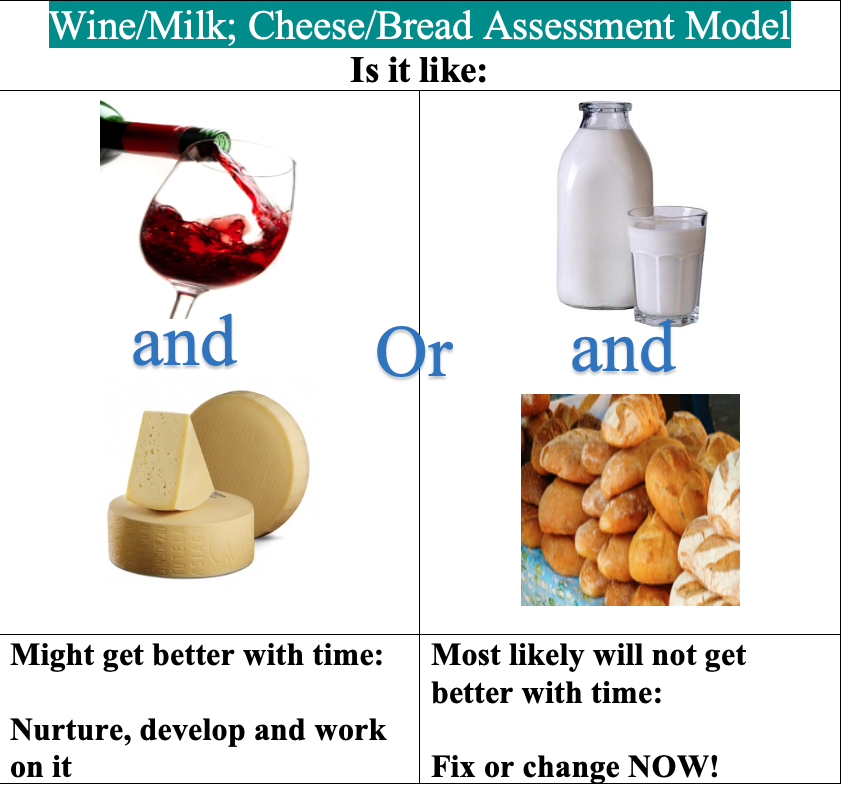
    • They employ the Wine/Milk; Cheese/Bread Assessment Model  for the opportunities and challenges they face:

    • Build and rely on the Team:
      • Think hard about the skills and experiences they need on the team and relentlessly pursue the right people- and don’t satisfice
      • Provide frequent and meaningful developmental experiences for their people:
        • Explicit and accountable endeavors
        • Endeavors important to the success of the organization
        • Guaranteed to shape perspectives, broaden scope and deepen skills
      • And if things are not heading in the direction they hope- See above: Wine/Milk;   Cheese/Bread Assessment Model

    For more information refer to: https://pmccinteractive.com/2020/01/24/background-information-for-pat-mccormick/

  • The conversation about the role of the CFO- and where she adds the most value continues- but the bottom line is that Finance counts!

    Thirty some years ago, we began research on the role of the CFO and the impact of financial leadership on the performance of the enterprise.  After interviewing and reviewing more than 50 organizations and engaging thousands of CFO/Financial leaders in workshops around the world, we found that there were several determinants of success.

    Moreover, we found great frustration on the part of CFO’s wanting a seat at the “business management/Strategy table” and the rest of leadership questioning why they needed/should have that seat.  While that conversation continues, the accompanying link to the Visual Capitalist shows that significant progress has been made and that the conversation continues and that is a good thing.

    Enjoy the link:  https://www.visualcapitalist.com/future-of-the-cfo/

    Meanwhile, each day, we continue to prompt the conversation and help Clients create value by  improving the business of their business

  • Business challenges are not like wine and cheese….

    Over the past few months, I have had scores of discussions with people working in and providing services to Private Equity Firms.  The conversations have been interesting and focused on questioning and challenging the status quo.  I thought it would be fair and appropriate to summarize the themes of the conversations for your consideration.

    Business challenges are not like wine and cheese…. but more like bread and milk– they are common, but don’t get better with time…

    These are the most frequently discussed and vexing themes….

    1. The strike zone is expanding- Longer holds don’t generally seem to represent additional opportunity for incremental growth and development- but place extraordinary pressure for returns and maintaining expected IRR’s for investors… creating additional risk with little prospect for incremental reward
    2. Velocity on the sell side is emanating from A companies, while B’s sit and search for a way out…Plentiful debt and plentiful equity in search of the A companies, make this segment of the market hypercompetitive and Strategics, PE firms and lenders are in the quest to provide a value add- and make their green money even brighter and shinier
    3. Everyone has them, few like to acknowledge it. Every portfolio has a “bottom 50%”– those companies that are under achieving expectations, or underperforming on an absolute basis.  The surest way to make money is to not lose any.  But, the time energy and attention placed on the challenged companies, tends to be a trap that saps attention from the higher performing companies that likely have an opportunity to outperform
    4. Management teams have been built and curated to focus on growth and development and set up for the exit…. but most don’t have significant successful experience in dealing with types of challenges presented by the “bottom 50%”
    5. Quality information is elusive.  It is a challenge to sustain a focus on relevant, reliable and readily available information to effectively run the business.  This delays or impedes problem recognition and response- and in some cases does not promote confidence in the strategies and steps necessary to “get out from under”- at the very time confidence and resolve is critical to break the cycle and drive improvements
  • Best wishes for a prosperous, healthy, happy and meaningful 2017


    As we move on to a new year, I wanted to take a time out to thank all of you that have supported PMCC Ventures in 2016.  I appreciate it.  We had an interesting year, and I hope we continued to serve our clients in the exact way they needed support- and to help them create value.

    As we committed at the beginning- now 10 years ago, we are once again sharing our reflections on our key learnings from the past year.  We share them in hopes that you find them interesting, but more importantly helpful in some situation you are yet to encounter.

    Most all of our assignments this past year, revolved around private equity, structured finance or dealing with some sort of performance gap.  It felt good to get back to our roots, as we really enjoy working in this space.  Not sure if it is our familiarity or the dynamics or both…  Each situation was different- and at the same time, they were the same.

    In the world that we work in, it is an oft repeated phrase: “But you don’t understand: We are different”.  So over the past year or so, we concentrated on understanding differences, but of course to do that effectively, we had to also focus on similarities.  We found that there are of course differences—but they are generally rooted in the management team and the backgrounds they brought to the current situation.  In the world of underachieving organizations, there are a lot of similarities- about what the company is experiencing- and how they got into the situations they are encountering.  Our reflections below will share some of those insights.

    We are going to place a lot of focus and intention on underperforming and underachieving organizations in 2017.  We know that there is a lot of opportunity created by organizations as they “bounce off the bottom”.  We want to work with them, to minimize the disruption and maximize the height of the bounce.


    Reflections on 2016

    Underperforming and underachieving organizations—similarities and differences-

    Conditions that seem to be common:

    • Markets in fluxDifficult to grasp meaningful movement and change in direction… differing pace and intensity of changes experienced serve to further disorient and generated confidence in a direction to follow
    • Leapfrogging technologiesShortening product life cycles… Difficulty keeping up with emerging opportunities and disappointments of disappearing opportunities… Uncertainty about where to place bets… Difficult to recover development costs… Staffing and knowledge base challenges…
    • Shifting customer needs, performance and loyaltiesCustomers face similar challenges… The importance of the relationship to weather these challenges is significant… keeping up with the various stages of relationships and lifecycle events was costly and required a lot of attention and time…Not getting it “right” was a death knell…
    • Critical resources: time, talent, capital and information are in short supply and not optimally appliedThe longer the challenge, the more resources evaporated or became stretched… Market and technology changes make it tough to keep fresh and relevant talent available to pounce on opportunities… Capital or loan opportunities are already stretched, making new sources a real challenge to obtain and likely costly… The lack of relevant information- particularly about changing conditions was the most insipient and critically important… Resources frequently diverted to ministerial matters and strategies that were not promising….
    • Shifting contexts are confusing and make it difficult to plan and act- systemically and consistentlyDifficulty keeping up with changing situations… Rest of organization characterizes management coping with this poorly, without fully understanding the volume of change, conflicting insights and information that management is juggling….
    • Time and focus shifts to dealing with ministerial duties and away from the things that help an organization create valueIncreased time dealing with regulators, lenders, investors, lawyers etc.…. less time and energy available to focus on customers, markets and operations… can become a spiraling situation further driving organization from value added thinking and action
    • Responses become operationaland less strategic…and less cognizant of the system…. less value placed on thinking and more on motion than forward action… concepts of motion and action became confused… More inwardly focused…. People satisfice and focus on surviving and not thriving

    Underperforming and underachieving organizations—Conditions that are different

    • Type of presenting issue…Industry wide… or specific to the organization… influences the dimensions and probability of positive outcomes
    • Management team Experiences… many teams’ experiences and persona are growth oriented… many individuals and rarely teams have the experiences to manage through the downside… Team members selected for deep functional excellence- when the premium capability… is cross-functional systemic thinking and action
    • The starting pointObjectively how deep is deep? … How much effort needs to be extended to get back to “even”
    • Recognition and resolution…How well does the team recognize the challenge at hand?… How prepared are they to come to grips with it… Denial,,, Anger… Acceptance… Resolution and Healing….
    • Time and what has transpired so farPassage of time and prior decisions and actions can either negatively or positively influence the outcome and the [re] starting point for any transformation activity
    • Capacity and capability… Influence the effort, the timing and the intensity of the change effort that can be applied- and hence the duration of the transformation period
    • The ability to execute the steps needed to … gain control and stabilize- what has been done- what needs to be done… when should it happen… distinguish urgent and critical… What might foreclose opportunities to maneuver later….
    • Resources… Does the organization have the resources (time… capital… talent… information) or can they be secured or created] to accomplish the necessary changes…. If not, what is a practical level of desired achievement in the best possible timeframe…

    Be diligent with diligence

    • Set a plan… Execute the plan…completely…. particularly in new or challenged situations… make sure that the basics of the deal are covered….  Risks are articulated and strategies in place to manage them… Know the structure that the new entities need to work within… head that direction… make sure that the inventory of service level and retention agreements are adequate and that they are favorable to provide the time and focus to accomplish “newco” requirements…Don’t assume… focus on key risks… identify transitional resources… remember, you don’t always get what you thought you would buy

    Strategy is not just adding and doing new things

    • Strategy is about placing resources and bets to win… it is not about adding efforts and requirements without ensuring that key resources are available…. .it is about making choices… overloading (or under-resourcing) an organization is a sure fire way to help a strategy fail…be thoughtful, realistic and practical about what it will take so succeed

    Strategic, financial and operational information is not like wine or cheese… the situation doesn’t get better with age when you don’t have them readily available

    • Integrated and systemic information is key to success… What insights do you need to run the business…is it readily available… against a context or model that makes sense for the business…Do the timeframes represented make sense…. Is it published in times and ways that can help make a difference… are all of the answers to the repeated or likely questions presented… Can you say immediately….” Now I understand” … Or do you have to do some of your own digging or calculations… Late or incomplete information are bad within themselves, but more importantly point to the existence of other organizational challenges…the organization that invests the effort to do this right will improve performance because of better insights…. And will improve processes and data models that will increase quality of controls… administrative effectiveness… efficiency….

    Marketing is a key turnaround tool and weapon

    • Getting the basics of marketing straight has never been more important…If you don’t understand your markets, your customers, their needs and wants- cold… be assured that someone else is trying to figure it out…and might beat you to the punch… Whether you deploy it physically, digitally or better- both… the basics are key…. No one has the time or the luxury of getting it wrong with customers today… few have extra resources to deploy in a wasteful way… though this waste is rarely evident- it represents a lot of cash and a lot of unmet opportunity…There is someone out there right now trying to know and attract your markets and customers… they just hired “that person” who knows x, y, or z technique cold—and they are deploying it for your customers…now
     

  • Turnaround of Community Mental Health Organization

    Client Engagement Summary

    Client Description:

    Public mental health organization

    Client Opportunity or Challenge:

    Client faced a myriad of challenges including but not limited to:

    • Weak financial planning and controls capabilities
    • Paucity of operational and management information
    • Bank wanted to foreclose on debt
    • Cost structure did not match declining revenue structure
    • Funding changes due to change in government regulation
    • Weak Billing practices and collections

    Role:

    Interim CFO and Chief Restructuring Officer

    Outcomes or Benefit:

    • Negotiated and extended debt agreements
    • Improved financial reporting with emphasis on operational reporting to discern profitable and non-profitable programs
    • Devised and executed strategies to either align program revenue and costs or to exit certain programs
    • Devised monthly performance management and accountability process to ensure that strategies were effective, being enacted and yielding intended results
    • Renegotiated leases for terminated programs without suit or extraordinary cash requirements for client
    • Agency has sold businesses, cash flow is improving and agency is poised for growth


    NOTE:

    Client names are not used because of Client privacy and Confidentiality Agreements.  Similarly, facts are cloaked to preclude people from deducing the Client name or situation.

  • Improving your Business IQ

    Relevant, Reliable and Readily Available information is key to improving the business of your business and acquiring the knowledge necessary to make smart moves.

    Attached is a recent presentation given at the introduction of Cognos Insight at Overbrook Golf Club.  The presentation outlines the business intelligence life cycle as well as provides four case examples where organizations have combined strategic, financial and operational information to make smart moves in their business to create significant value.  Click here to go to the Business IQ Presentation

  • Effective Financial Management- Setting a Developmental Agenda

    In most instances, enhancing financial management capabilities will require that leaders not just focus on that which can be made more effective and efficient- that is obvious and easy and does not create a lot of value.  Instead, Finance leaders will have to both focus on efficiency and at the same time focus on what has been missing and create those capabilities from the “ground up”.

    I recently attended a local CFO Breakfast.  The breakfast theme was financial leadership-and it lead to a lot of different interpretations in the discussion- but some common themes emerged and not all of them are new.

    • Role of finance
    • How can finance “get more respect” be more vital etc?
    • What should finance be working on….

    The answers are of course:  It depends on the individual circumstance.  I go to the school that all improvements are good improvements- and that the value of investing in upgrading capabilities will eventually accrue to the organization.  However, absent a specific change agenda, I suggest that Finance Leaders consider the following scenario and plan their mid to long term development agenda around the needs suggested in the scenario below:

    • Investors will always demand incremental returns….
    • There  is significant cash on the sidelines of public companies and investment funds
    • So …Companies will have to invest or return cash to shareholders or limited partners- which for a whole host of reasons, there is a general reluctance to do so…
    • Hence …there is pent up demand to invest- and in the Spring of 2011 this is playing out in the volume of announced large strategic deals
    • Meanwhile,,,, Banks are offering less leverage than once considered “normal”
    • And…. Lack of leverage staunches the ability to increase returns using financial engineering techniques
    • At the same time it appears that…. developed economy countries economies will not grow very rapidly in the near term and therefore not provide volume growth opportunities to the market
    • Hence….“Class of 2011 and likely 2012” deals will have to get their returns the old fashioned way- they will have to earn them through
      • Market Innovation- new products and new markets
      • Operating excellence- achieve best cost operations
      • Working capital creation and increased velocity
      • Causing…. the overall competitive environment to intensify as mergers and acquisitions that are sure to follow an economic downturn take place but in new formats and capital structures
      • And….place pressure on all competitors for enhanced performance
      • Which… if not properly managed could start the economic challenges giving rise to this scenario to start all over again…. Just when we thought we were emerging….

    To deal effectively in this environment, companies and their finance leaders will both have to ensure that the skills and capabilities in the finance group are sharp as well as ensure that the organization as a whole understands and is focused on driving returns for the business.

    If these assumptions are plausible for your organization, it stands to reason that companies will need to have above average capabilities in most all of the five following domains.  In fact the capabilities will have to be so good that they will both enable profitable innovation and growth- as well as pave the way for solid operating performance- and today, not many companies are necessarily good at both.

    Domain Relative Financial Management ability required in the business
    Financial Planning, Control and accountability Businesses will have to plan with more rigor to ensure that scarce resources are allocated in ways that will drive value and produce measurable results in the expected timeframes; Accountability processes will have to be real time and responsive to changing market conditions and company performance.
    Information for Decision Making Business leaders will need to have relevant, reliable and readily available information where and when they need it- in the formats that promote insight and compel action.
    Cost Structure Understanding Companies will not have just have to have low cost- they will require a best cost approach to the business- that is integrated- investing, cost cutting and operating rigor can’t operate independently. For success, they will have to operate together.  Capabilities will have to be in place so that people designing operations are doing so with the cost structure in mind so that they can make appropriate optimizing trade-offs and decisions.
    Business Literacy People planning and commanding resources will have to have a firm sense of the business of the business of how profits are earned and value is created so that they can make real time tradeoffs and decisions.
    Working Capital Capital deployment will be key.  Idle assets will have to be turned into cash and invested or used to meet the capital requirements of the business.    Similarly, returns on new capital invested will have to be closely monitored to ensure sustainable value creation.

    Time is tight and the stakes are high. Financial leaders will have to take stock to ensure that not only do individuals in the business possess capability and capacity in these domains, but that the fundamental business practices and processes are in place to effectively use and deploy these capabilities.  Some organizations will have to do some quick make or buy analyses to determine their organization’s own capabilities and the most expeditious path to developing and deploying them.

    • How do you rate your organization’s abilities in these domains in light of your business requirements?
    • What can you do to ensure your finance organization is up to the task?
    • What’s in the way of you accomplishing what you need to accomplish?